
There’s a reason your hair always looks and feels different after a professional salon visit – and it’s not just the blow-dry technique. Professional hairdressers operate with a level of knowledge about hair science that most clients never see and most home routines never apply. Some of it is technical, some of it is surprisingly simple – but all of it makes a real, visible difference. Here’s what the professionals know that most people don’t.
pH is everything
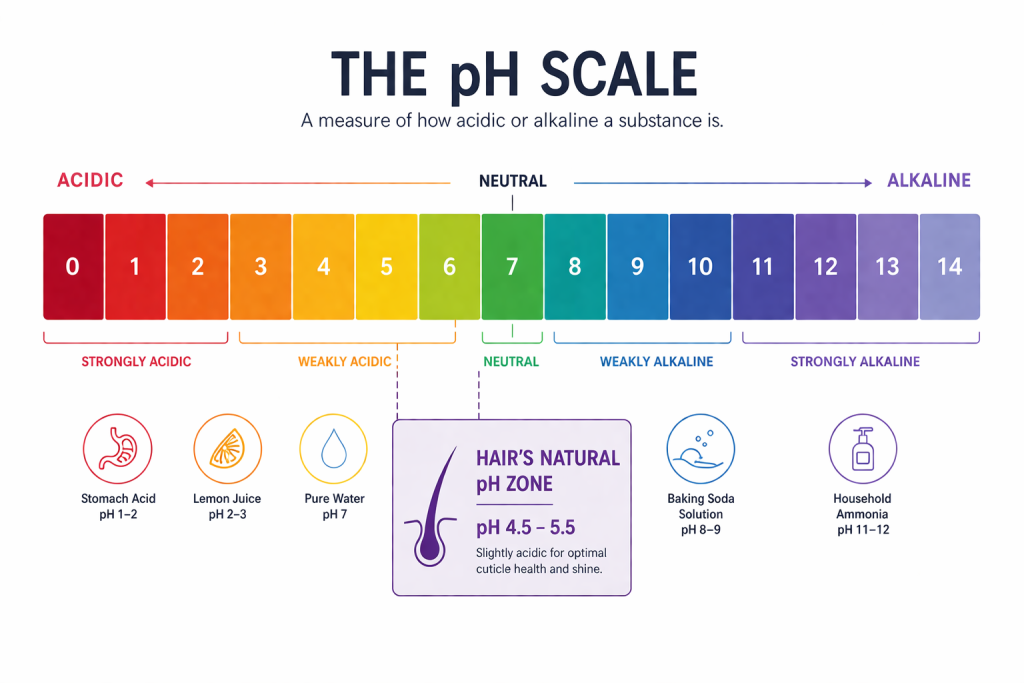
This is probably the single most important thing professional hairdressers understand that most people don’t. Your hair has a natural pH of around 4.5 to 5.5 – mildly acidic. At this pH, the cuticle lies flat, the hair is smooth, shiny and protected, and it holds moisture effectively.
Shampoos are alkaline – they need to be to open the cuticle and cleanse. Most are pH 7 to 9. That’s fine for the shampooing process, but it means you’re finishing every wash with your cuticle in an open, alkaline state – vulnerable to moisture loss, frizz, breakage and environmental damage.
Professional hairdressers always close the cycle. Every alkaline step is followed by an acidic one – a low-pH treatment, a pH-correcting sealer, a final cool rinse. This is the fundamental structure of professional hair care, and it’s the step that home routines almost universally skip.
Your hair is either losing protein or moisture — usually both
Healthy hair is a balance of protein and moisture. Protein gives hair its strength and structure. Moisture gives it flexibility and elasticity. When either is depleted, hair behaves differently and looks worse.
Protein-depleted hair: stretches without springing back, feels limp and weak, breaks easily, doesn’t hold a curl or a style. Moisture-depleted hair: feels dry, brittle and rough, snaps rather than stretches, looks dull and frizzy.
Heat styling depletes moisture. Chemical services deplete protein. Hard water depletes both. A good professional hairdresser assesses which is more depleted and recommends treatment accordingly – not just applying the same conditioner regardless of what the hair actually needs.
The weekly reset is non-negotiable
Every professional hairdresser worth their reputation recommends a weekly clarifying shampoo. Not because your regular shampoo isn’t working, but because no regular shampoo is formulated to remove mineral deposits, chemical residue and styling product build-up from inside the hair shaft.
Hard water minerals, chlorine, product residue and chemical build-up accumulate in the hair over time and progressively dull its condition. A weekly chelating clarifying shampoo removes all of this – resetting the hair and allowing everything else you apply to actually work.
This is why hair feels so noticeably better after a salon wash – the salon shampoo protocol almost always includes a clarifying step that home routines skip.
Cheap shampoos cost you more in the long run
The quality difference between a professional shampoo and a supermarket one isn’t just marketing. The concentration of active ingredients, the quality of the cleansing agents and the formulation pH are all significantly different.
Many budget shampoos use harsh sulfates that strip the hair aggressively – technically getting it clean but damaging the cuticle in the process. They also often have a higher pH than is ideal, leaving the cuticle open after washing. Over time, the cumulative damage means you end up spending more on treatments and conditioners to repair what the shampoo has stripped.
Professional hairdressers use and recommend professional shampoos not because of brand loyalty, but because the formulations are genuinely different and produce genuinely different results.
The system is everything
This is perhaps the biggest insight that separates professional hair care from home hair care. Professionals don’t think in individual products – they think in systems. Every product has a role, and each step prepares the hair for the next.
The structure is always the same: cleanse, treat, seal, style. The weekly clarifying shampoo resets. The daily shampoo or clenzer cleanses at the right pH. The treatment rebuilds protein and moisture. The sealer closes the cuticle and locks everything in. The styling product finishes and holds without building up.
When every step is present and the products work together as a system, the results compound. Hair that’s been on a consistent professional system for two to three months looks and behaves categorically differently to hair that’s been using random individual products from different ranges.

Heat protection is not optional
Every professional hairdresser will tell you the same thing about heat styling – it’s not whether you protect your hair, it’s how effectively you do it. Water inside the hair shaft literally boils when exposed to high heat – expanding rapidly and causing internal structural damage that looks fine initially but leads to increasing porosity, dryness and breakage over time.
Effective heat protection means using a product specifically formulated to coat the hair shaft and create a thermal barrier before any heat is applied – not just a conditioner or a serum applied as an afterthought.
Less product, more consistently
A common mistake in home hair care is using too much product in one go and then going long periods without any. Professionals take the opposite approach – smaller, consistent amounts applied regularly as part of a structured routine.
More product doesn’t mean better results. It means more build-up, more residue and more work to reset. The professional approach is precision – the right product, in the right amount, at the right stage of the routine, consistently.
The bottom line
The gap between salon hair and home hair isn’t really about access to professional tools or exclusive products – it’s about knowledge. Understanding pH, protein-moisture balance, the importance of the weekly reset and the value of a systematic approach is what separates professional hair care from guesswork.
Apply these principles to your home routine and the results will follow.
